


Over 700 GPs protest Health Ministry's drug price display rule at PMO
More than 700 private doctors gathered at the Prime Minister’s Office today to protest the enforcement of the Price Control and Anti-Profiteering (Price Marking for Drugs) Order 2025.
The gathering, organised by the Malaysian Medical Association (MMA), drew participation from 15 medical groups nationwide.
Dressed in black, the general practitioners initially planned to...
Summary
Doctors protest the inequity of their consultation fees remaining fixed at RM35 whilst service providers such as plumbers and locksmiths earn significantly more.
They oppose being regulated under Act 723 of Price Control and Anti-Profiteering Act 2011, when a healthcare-specific Act 586 of the Private Healthcare Facilities and Services Act 1998 already exists.
More than 700 private doctors gathered at the Prime Minister’s Office today to protest the enforcement of the Price Control and Anti-Profiteering (Price Marking for Drugs) Order 2025.
The gathering, organised by the Malaysian Medical Association (MMA), drew participation from 15 medical groups nationwide.
Dressed in black, the general practitioners initially planned to march from the Health Ministry’s headquarters, about 500m away, but Malaysiakini was informed that the police advised them to cancel the march and assemble directly at the intended venue instead.
“We came by bus from Perak, one bus and a few other doctors travelled separately.
“Most of us didn’t close our clinics for this, as we understand our patients’ needs are important,” Dr R Jeyaratnam, a former military doctor, told Malaysiakini.

Another doctor, who wished to remain anonymous, said he closed his clinic in Kuala Lumpur to attend the protest in solidarity.
Some doctors were observed carrying placards lamenting the rise in chicken and fish prices - and even Malaysia's favourite dish, nasi lemak - whilst their consultation fees have remained unrevised for more than three decades.
Several others were seen with placards questioning whether it was fair that the consultation fee for general practitioners remains at RM35, whilst locksmiths and plumbers earn RM200 and RM150 respectively, for their services.
Doctors’ grievances
At the heart of their grievance lies the government's decision to enforce medicine price displays using Act 723 under the Price Control and Anti-Profiteering Act 2011.
The doctors lamented that it’s a law designed for retail businesses rather than healthcare settings. The Price Control and Anti-Profiteering (Price Marking for Drugs) Order 2025 falls under this.
The doctors argued that they're already subject to Act 586 of the Private Healthcare Facilities and Services Act 1998, which specifically governs their profession.
This dual regulation, they said, creates an enforcement overlap that threatens to generate confusion and potentially disrupt primary healthcare services in the country.
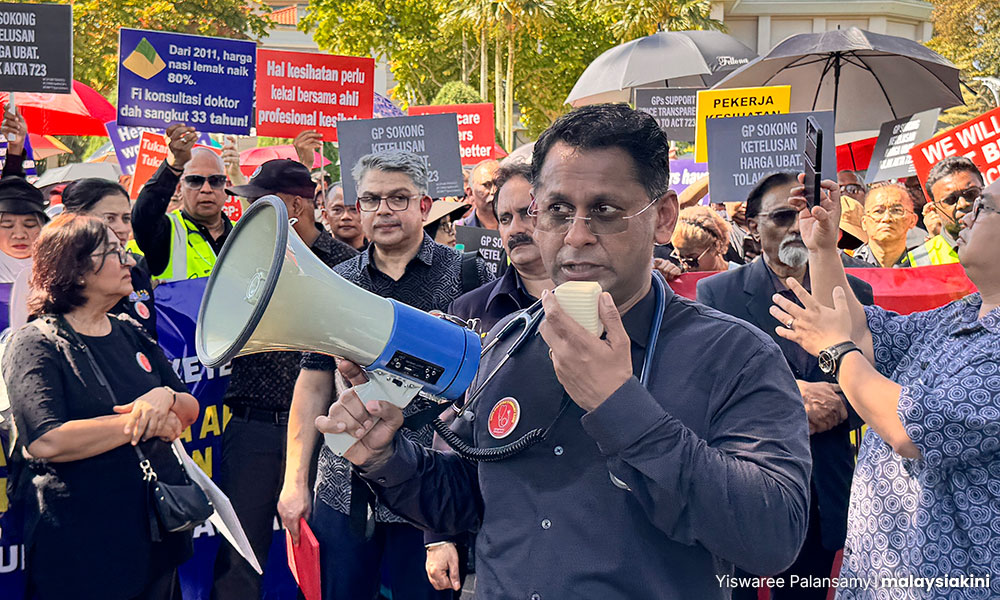
"If we look at this professional sector, there are many components. The (main) component is the duty of care. So, the duty of care includes the journey of a patient from their entry into a registered clinic until they see a doctor, take their medicines and go back.
"So, throughout this journey, there are 54 Acts and regulations that regulate this private medical sector. So, when a new Act comes, we feel stuck," MMA president-elect Dr Thirunavukarasu Rajoo said in his speech at the protest.


Report this comment
Are you sure you want to delete this comment?
This action cannot be undone.